
This Pick Checks the Right Boxes Today
The pick
- Matchup
- Utah Jazz @ Dallas Mavericks
- Our pick
- Dallas Mavericks -7.5 Spread
- Game time · Eastern
- 8:00 PM
The Analysis
The Dallas Mavericks return home Friday night with a strong opportunity to end their brief two-game losing streak when they host a Utah Jazz team that has been heading in the opposite direction for nearly two weeks. Dallas enters 4-4, while Utah sits at 1-7 and has lost six consecutive games, including Wednesday’s 120-113 overtime defeat in New Orleans. The current market has Dallas favored by 7.5 points at several major sportsbooks, with the total around 225.5 to 226.5. Utah has shown enough individual scoring to make games competitive, but the Jazz have not consistently defended well enough or produced enough efficient offense to finish those games. For today’s free pick, we’re backing Dallas -7.5 to use its healthier star power, superior shooting efficiency and home-court setting to pull away.
The early-season efficiency gap explains why Dallas can be trusted despite entering off consecutive losses. Utah is scoring only 107.8 points per game while allowing 119.0, giving the Jazz an average margin of roughly minus-11 points per night, while Dallas is essentially even at 112.1 scored and 112.2 allowed. Rating data places Utah around 29th offensively with a net rating near -11, compared with Dallas around the middle of the league with an essentially neutral net rating. That means Utah’s 1-7 record has not been created by a series of unlucky one-possession endings; the Jazz have simply been outplayed over the full sample. Dallas does not need an elite performance to cover if Utah continues producing at those season-long levels.
Utah is expected to start Keyonte George at point guard, Darryn Peterson at shooting guard, Ace Bailey on the wing, Lauri Markkanen at power forward and Jaxson Hayes at center. Dallas is projected to counter with Kyrie Irving, Max Christie, Cooper Flagg, P.J. Washington and Daniel Gafford, although Christie remains listed probable because of right hip soreness. Those lineups immediately highlight Dallas’ advantage in proven shot creation because Irving and Flagg can both initiate offense while Washington supplies another versatile frontcourt scorer. Official starters normally are not confirmed until closer to tip-off, but those are the most consistently projected groups Friday morning.
The most important frontcourt difference comes from who is not available for Utah. Jaren Jackson Jr. is out with a torn right MCL and is expected to miss roughly six to eight weeks, while Jusuf Nurkić remains sidelined by a right-foot plantar-plate injury. That removes two of Utah’s most physical interior players and forces Markkanen, Hayes, Mohamed Bamba and the younger forwards to absorb additional responsibility around the rim.
Kyrie Irving is the biggest reason Dallas’ recent two-game skid should not be viewed the same way as Utah’s six-game slide. Irving missed Monday’s 115-100 home loss to Sacramento but returned Wednesday in San Antonio and scored 29 points, adding seven rebounds and five assists despite Dallas falling 112-111. He also scored 35 points in the Mavericks’ NBA Cup victory over Houston, meaning his two most recent appearances have been his two highest-scoring performances of the young season. When Irving is available, Dallas has a half-court shot creator who can manufacture efficient offense even when the initial action breaks down. Against a Jazz defense allowing 119 points per game, that individual shot-making advantage matters significantly.
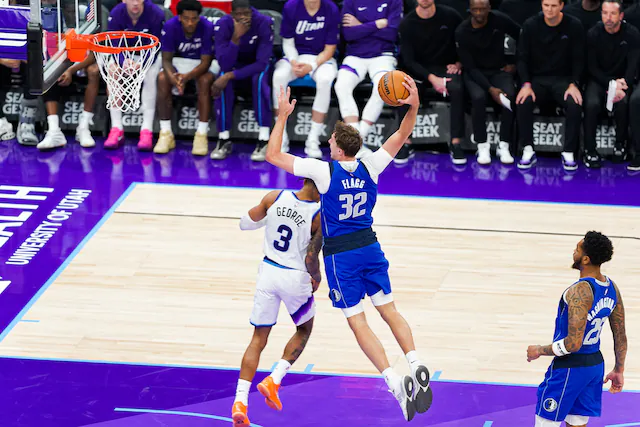
Cooper Flagg enters as Dallas’ leading scorer at 24.3 points per game, and the reigning Rookie of the Year has quickly become much more than a complementary piece around Irving. He recorded 19 points and 10 rebounds against San Antonio, giving Dallas production even on a night when his shot was not especially efficient. Flagg’s combination of size, transition speed and ball handling creates particular problems for a Utah roster missing Jackson, who normally would have been one of the Jazz’s most natural physical defenders for this assignment. Markkanen and Bailey have enough length to challenge Flagg, but neither should be asked to absorb repeated downhill drives while also carrying major offensive responsibility. Dallas should make Utah defend Flagg in movement rather than allowing the Jazz to load up against stationary isolation possessions.
The most important statistical argument supporting Dallas -7.5 is Utah’s offensive efficiency. Current rating data puts the Jazz at roughly 103.9 points per 100 possessions, 29th in the NBA, while Dallas is around 112.5 in the same metric. Utah is shooting only about 43% from the field and 31.5% from three, which makes it extremely difficult to overcome defensive stretches where the opponent scores efficiently.
The Jazz can generate free throws and offensive rebounds, but those advantages have not been enough to consistently create league-average offense. A team laying 7.5 becomes much easier to support when the underdog struggles simply to reach the 110-point range.
Dallas also owns a useful matchup advantage on the perimeter because opponents have shot only around 30% from three against the Mavericks through the opening games. Utah is already one of the poorer three-point shooting teams in the league, meaning its largest existing offensive weakness runs directly into one of Dallas’ better defensive results. Keyonte George and Markkanen can certainly make difficult threes, but Utah cannot reasonably expect both of them to carry the entire offense from the perimeter.
Markkanen remains Utah’s most established veteran scorer, but he enters Friday playing through a wrist problem that has affected him since an October 26 game against Memphis. Utah coach Will Hardy acknowledged that Markkanen has been “in a lot of pain”, while also asking him to spend more time at center because of the injuries to Jackson and Nurkić. He has still produced consecutive 20-point performances, including 21 points and 10 rebounds against the Pelicans, which shows the injury has not made him ineffective.
The problem is that playing additional center minutes requires him to defend more physical players and absorb more contact around the rim. Dallas should use Gafford, Washington and Flagg to make Markkanen work defensively rather than allowing him to conserve energy entirely for offense.
Jaren Jackson Jr.’s injury does not only remove 16-plus points per game from Utah’s offense; it also removes one of the best rim-protecting big men on the roster. Nurkić’s absence further reduces physicality and rebounding depth, leaving Hayes and Bamba responsible for more traditional center minutes. Hayes fouled out in only 21 minutes against New Orleans, which illustrates how quickly Utah’s frontcourt rotation can become vulnerable if opponents consistently attack the paint. Dallas should use Irving-Flagg actions, Washington drives and Gafford rolls to force Utah’s remaining big men to defend multiple actions within the same possession. If Hayes gets into foul trouble again, the Jazz may be forced into combinations that are either undersized or uncomfortable defensively.
The Mavericks are not entering in perfect form either, and their 115-100 home loss to Sacramento is the biggest warning sign surrounding this pick. Dallas followed that performance by falling 112-111 in San Antonio, but the second loss looked significantly better because the Mavericks erased a 19-point deficit and had a chance to steal the game late. Irving scored 29, Washington had 21 points and 10 rebounds, Flagg produced 19 and 10, and Marshall added 22 from the bench. Losing to a Spurs team led by Victor Wembanyama’s 52-point, 24-rebound performance is very different from struggling against a 1-7 Utah roster missing two important centers. Dallas should view Friday as a chance to correct the Sacramento performance rather than allowing a two-game slide to become something larger.
Dallas is Utah’s overall efficiency profile, with the Jazz sitting near the bottom of the NBA offensively and carrying a net rating around minus-11. The second is Kyrie Irving’s return to form, with 35 and 29 points in his last two appearances giving Dallas the best established half-court scorer in the matchup. The third is Utah’s depleted frontcourt, with Jackson and Nurkić unavailable against Flagg, Washington and Gafford. The fourth is Utah’s 0-3 road record and six-game losing streak, which have repeatedly exposed the Jazz’s difficulty sustaining quality play for four quarters. Finally, Dallas is 5-3 against the spread while Utah is 1-7 ATS, showing that the market has consistently underestimated the gap between Utah and its opponents early in the season.
Everything begins with Irving and Flagg attacking Utah’s weakened interior rather than Dallas settling into a perimeter shooting contest. George may score efficiently enough to keep Utah competitive early, but the Jazz need much more than one hot guard to survive a full game against Dallas’ deeper creation. If the Mavericks force Utah toward its season-average offensive efficiency and reach somewhere around 118 to 120 points themselves, the spread becomes very manageable. Dallas should also have an advantage late because Irving gives it a reliable closer while Utah remains heavily dependent on George and Markkanen. That combination creates a realistic path to a double-digit Mavericks victory.
Utah has enough young talent to make the first half competitive, and George’s 39-point performance against New Orleans proves the Jazz cannot simply be dismissed because of their record. The broader matchup still points toward Dallas because the Mavericks have the healthier star core, stronger offensive efficiency, better perimeter defense and a major frontcourt opportunity with Jackson and Nurkić unavailable. Irving has returned in excellent scoring form, Flagg continues producing like the centerpiece of the franchise, and Marshall’s return gives Dallas another reliable scorer off the bench. If the Mavericks avoid the slow start that hurt them in San Antonio and keep Utah from living at the free-throw line, the Jazz should struggle to generate enough efficient offense to remain inside the number for 48 minutes. We’re backing Dallas -7.5 to end its two-game skid and improve to 2-0 in NBA Cup group play.
See more of the game
Checking your account…